Author Guidelines
Essential information for authors submitting manuscripts
General Information
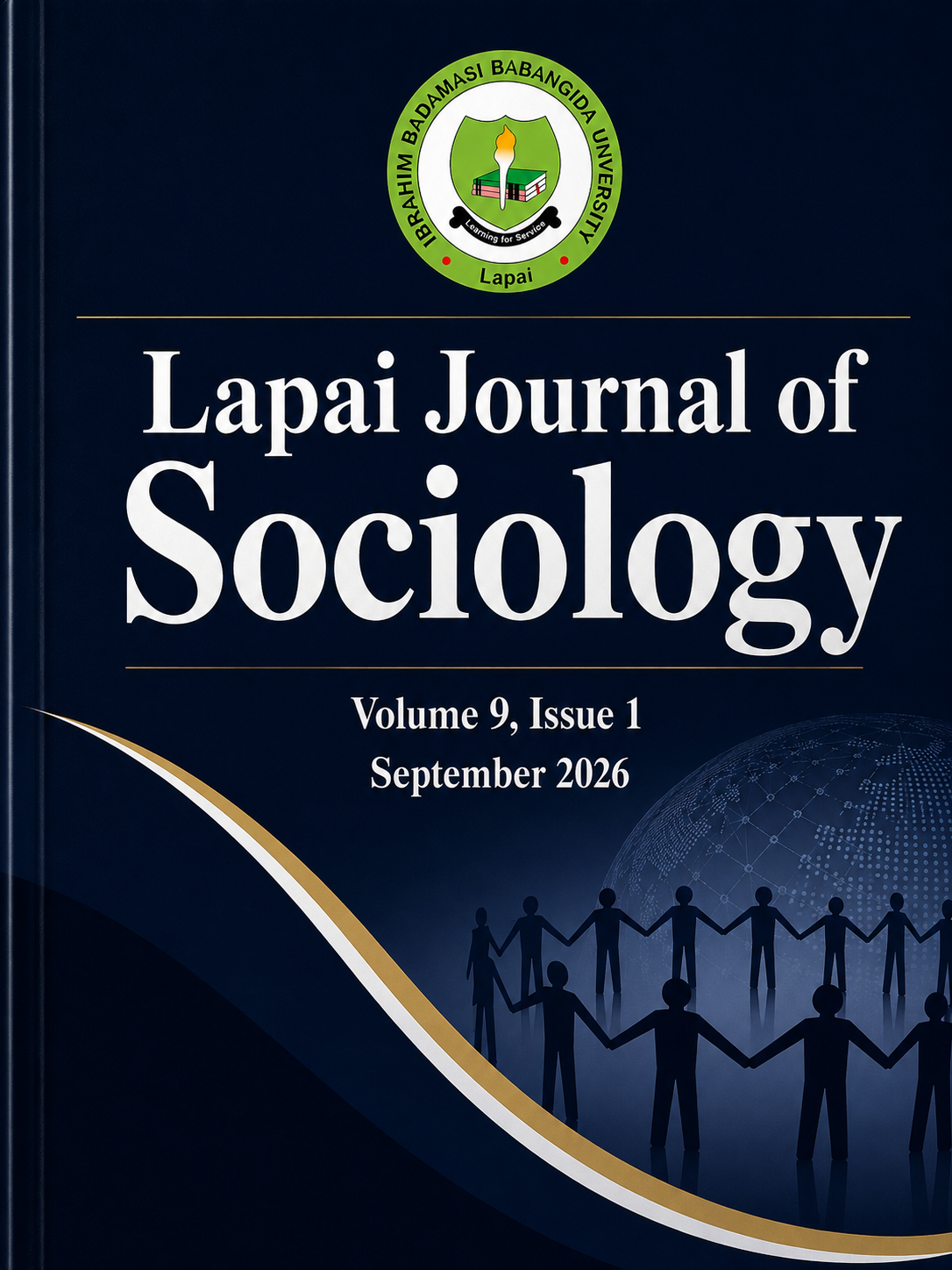
The Lapai Journal of Sociology (LJS) is a peer-reviewed, multidisciplinary journal of the Department of Sociology, Faculty of Social Sciences, Ibrahim Badamasi Babangida University, Lapai, Niger State, Nigeria. It appears twice a year, in March and September.
The journal publishes well-researched empirical and theoretical work in sociology, anthropology, political science, economics, mass communication, gender studies, gerontology, public administration and closely related fields. Authors should read the journal's Aims & Scope before submitting; manuscripts falling outside it may be declined without external review.
Every manuscript submitted to LJS must be the original work of the author(s). It must not have been published elsewhere, in whole or in substantial part, and it must not be under consideration by any other journal. Submission is taken as a statement by the author(s) that these conditions are met, and that all named authors have seen and approved the manuscript.
Manuscripts must be written in clear, concise English (British spelling). Authors whose first language is not English are strongly advised to have their work read by a competent English speaker before submission. Papers that are difficult to read may be returned without review.
Types of Manuscripts Accepted
- Original Research Articles — full reports of original empirical research, whether quantitative, qualitative or mixed-methods. Maximum 8,000 words, including tables, figures and references.
- Theoretical and Conceptual Papers — papers that develop, extend or critique social theory, or that build a conceptual framework of use to the discipline. Maximum 8,000 words.
- Review Articles — critical, systematic or integrative reviews of the literature on a defined problem. Reviews must be analytical rather than merely descriptive, and should end with a clear statement of what remains unresolved. Maximum 8,000 words.
- Methodological Papers — papers advancing or appraising research methods and techniques in the social sciences. Maximum 7,000 words.
- Research Notes and Short Communications — concise reports of preliminary findings, replications or focused analyses. Maximum 3,500 words.
- Book Reviews — critical reviews of scholarly books published within the preceding three years. Maximum 1,500 words. Full bibliographic details of the book, including publisher, year, number of pages and ISBN, must head the review.
Word limits are firm. An author who has good reason to exceed a limit should write to the Editor-in-Chief for permission before submitting.
Manuscript Preparation and Format
- Manuscripts must be prepared in Microsoft Word (.doc or .docx). PDF-only submissions are not accepted.
- Use Times New Roman, 12 point, double-spaced throughout, including the abstract, block quotations, notes, tables and references.
- Use A4 paper size with 1 inch (2.54 cm) margins on all sides.
- Number every page and, where your word processor allows it, number the lines. This makes reviewers' comments easier to locate.
- Use headings sparingly and consistently, following APA 7th edition heading levels. Do not number headings.
- Present numbers, units and statistics consistently, and report statistics in APA style (for example, t(48) = 2.31, p = .025).
- Footnotes should be used only where genuinely necessary, and never as a substitute for citation. Endnotes are not accepted.
Preparing for blind review
LJS operates double-blind peer review. Authors must therefore submit two files:
- A title page containing the title of the paper, the full name of each author, institutional affiliation, email address, phone number and ORCID iD (where available), and a clear indication of the corresponding author.
- The main manuscript, fully anonymised. Remove author names, affiliations, acknowledgements, funding statements and any self-identifying phrase such as “as we argued in our earlier study”. Replace self-citations in the text with “Author (year)” and remove the matching entries from the reference list until the paper is accepted. Remember also to clear author information from the document's file properties.
Structure of the Manuscript
Empirical papers should be organised in the following order:
- Title — concise, informative and no longer than 15 words. Titles that state the substantive claim are preferred to titles that merely name a topic.
- Abstract — a single paragraph of not more than 250 words, covering the problem addressed, the objectives, the methodology (design, study area, population, sampling and instruments), the principal findings and the conclusion. The abstract must contain no citations, tables or abbreviations.
- Keywords — five keywords, separated by commas, that do not simply repeat words in the title.
- Introduction — the background to the problem, the gap in existing knowledge, the objectives of the study and, where applicable, the research questions or hypotheses.
- Literature Review and Theoretical Framework — a critical engagement with relevant scholarship and a clear statement of the theory or perspective guiding the study.
- Methodology — research design, study area, population, sample size and sampling technique, instruments of data collection, validity and reliability, method of data analysis, and ethical clearance. Studies involving human participants must state the source of ethical approval and how informed consent was obtained.
- Results / Findings — presented clearly and without interpretation.
- Discussion — interpretation of the findings in relation to the literature and the theoretical framework.
- Conclusion and Recommendations — what the study establishes, what follows from it for policy or practice, and the limitations of the work.
- References — APA 7th edition (see below).
- Tables, Figures and Appendices.
Theoretical, conceptual and review papers need not follow this sequence rigidly, but must still open with an abstract and keywords and close with a conclusion and a reference list.
Citations and References (APA 7th Edition)
LJS uses the Publication Manual of the American Psychological Association, 7th edition (APA 7th). This is the only acceptable referencing style. Manuscripts referenced in any other style will be returned for correction before review.
In-text citation
- One or two authors: (Adamu, 2021); (Adamu & Bello, 2021).
- Three or more authors: (Adamu et al., 2021) at every mention.
- Direct quotations must carry a page number: (Adamu, 2021, p. 47). Quotations of 40 words or more are set as an indented block without quotation marks.
- Where several sources support one point, order them alphabetically and separate them with semicolons: (Adamu, 2021; Musa & Yusuf, 2019).
Reference list
Begin the reference list on a new page, arrange entries alphabetically by the surname of the first author, and use a hanging indent of 0.5 inch. Every source cited in the text must appear in the list, and every entry in the list must be cited in the text. Include the DOI of any source that has one, written as a full link (https://doi.org/...).
Journal article
Adamu, S. A., & Bello, M. K. (2021). Rural livelihoods and household food security in North-Central Nigeria. Lapai Journal of Sociology, 12(1), 33–51.
Book
Tinuola, F. R. (2019). Ageing and social change in Nigeria (2nd ed.). University Press.
Chapter in an edited book
Salihu, M. E. (2020). Informality and urban labour markets. In A. Yusuf & K. Ibrahim (Eds.), Work and society in West Africa (pp. 115–140). Ahmadu Bello University Press.
Thesis or dissertation
Musa, H. A. (2018). Migration and family structure in Niger State [Unpublished doctoral dissertation]. Ibrahim Badamasi Babangida University, Lapai.
Report or online source
National Bureau of Statistics. (2022). Nigeria multidimensional poverty index 2022. https://nigerianstat.gov.ng
Tables and Figures
- Tables and figures must be self-explanatory and must not simply duplicate material already in the text.
- Number them consecutively in Arabic numerals in order of first mention (Table 1, Table 2; Figure 1, Figure 2), and refer to each one at the appropriate point in the text.
- Each table carries a brief title above it; each figure carries a caption below it. Explanatory matter belongs in a note beneath the table, not in the title.
- Tables must be created with the word processor's table tool. Tables supplied as images cannot be typeset and will be returned.
- A table should not exceed 10 columns, and a table running longer than one printed page should be reconsidered or moved to an appendix.
- Figures, maps and photographs should be supplied at a resolution of at least 300 dpi, and must remain legible in greyscale, since hard copies are printed in black and white.
- Where a table or figure is reproduced or adapted from another source, obtain written permission where required and give a full credit line beneath it.
- Define every abbreviation and non-standard symbol in a note to the table or figure in which it first appears.
Submission Procedure
All manuscripts must be submitted through the journal's online system. Submissions by email or in hard copy are not accepted.
- Create an account at ljs-ibbu.com.ng/admin/register, using an institutional email address where possible.
- Complete your profile, including your full name as it should appear in print, your affiliation and your ORCID iD.
- Upload your manuscript, attaching the anonymised main file and the separate title page, and enter the details of every co-author in the order in which they should be credited. Indicate which author is the corresponding author.
- Pay the assessment fee and upload evidence of payment. A manuscript is not entered into the review process until this fee is confirmed.
- Track progress by signing in at ljs-ibbu.com.ng/admin/login. Every decision and request for revision is recorded there and sent to the corresponding author by email.
The corresponding author is responsible for all communication with the editorial office, for keeping co-authors informed, and for responding to reviewers on behalf of the team.
Revised manuscripts
A revised manuscript must be uploaded through the same account. Attach a point-by-point response to each reviewer comment, stating what was changed and where, and mark all changes in the manuscript itself using coloured text or tracked changes. Revisions returned without a response document will be sent back to the author. Unless the decision letter states otherwise, revisions are due within four weeks.
Peer Review Process
LJS operates a double-blind peer review process: reviewers are not told who the authors are, and authors are not told who the reviewers are.
- Editorial screening. The Editor-in-Chief first examines the manuscript for fit with the journal's scope, originality, structure and compliance with these guidelines. Manuscripts that fail this stage are returned to the author without external review.
- Plagiarism check. Every manuscript is screened with similarity-detection software. A similarity index above 20 per cent, or any evidence of copied text, fabricated data or manipulated images, results in outright rejection.
- External review. Manuscripts that pass screening are sent to at least two independent reviewers with expertise in the subject area.
- Decision. On the strength of the reviews, the Editor-in-Chief returns one of four decisions: accept, accept with minor revisions, major revisions required, or reject. Where reviewers disagree materially, a third reviewer is appointed.
- Acceptance and production. Once revisions are accepted, the author pays the publication fee, a formal letter of acceptance is issued, and the article is copy-edited and typeset. Proofs are sent to the corresponding author for correction of typographical errors only; substantive changes cannot be made at proof stage.
The editorial office aims to return a first decision within six to eight weeks of submission. The decision of the Editor-in-Chief on any manuscript is final.
Charges
- Assessment Fee: All articles submitted to the journal must be accompanied by a non-refundable fee of Ten Thousand Naira Only (₦10,000.00). The fee covers editorial screening, plagiarism checking and the cost of peer review, and is not refunded if the manuscript is rejected.
- Publication Fee: Upon acceptance of a manuscript, the author(s) will be required to pay a publication fee of Twenty Five Thousand Naira Only (₦25,000.00). A formal letter of acceptance is issued once this fee is confirmed.
- Hard Copies: The journal is freely accessible online. Printed copies are produced on request and attract an additional charge, determined by the prevailing cost of production at the time of the request.
All payments are made through the journal's online system, which issues a receipt against the manuscript. Authors should not make payments into any personal account, and the editorial office will never ask them to do so.
Publication Ethics
LJS is committed to the highest standards of publication ethics and follows the principles of the Committee on Publication Ethics (COPE).
Authorship
Authorship is limited to those who have made a substantial contribution to the conception or design of the work, or to the acquisition, analysis or interpretation of the data; who have drafted or critically revised the manuscript; and who have approved the version submitted. Those who assisted without meeting these criteria should be named in the acknowledgements instead. Requests to add, remove or reorder authors after submission must be made in writing by the corresponding author, with the agreement of all authors.
Originality and misconduct
Plagiarism in any form, including self-plagiarism, duplicate submission, redundant publication, data fabrication or falsification, and the manipulation of images, is regarded as serious misconduct. Where it is established after publication, the article will be retracted, the author's institution notified, and further submissions from the author declined.
Ethical research conduct
Research involving human participants must have been approved by a recognised research ethics committee, and that approval must be reported in the methodology. Participants' informed consent must be obtained and their confidentiality protected; no identifying detail may appear in the article without explicit written consent.
Conflict of interest and funding
All authors must disclose any financial, institutional or personal relationship that could be seen to influence the work. Where none exists, this should be stated. Sources of funding must be acknowledged, with grant numbers where applicable. These declarations are placed on the title page during review and printed in the accepted article.
Corrections
Authors who discover a significant error in their published work must notify the editorial office promptly so that a correction or retraction can be issued.
Copyright and Access
Submission of an article to the Lapai Journal of Sociology indicates the author's consent to the transfer of copyright in the article to the journal upon acceptance. Authors retain the right to use their own work for teaching, for deposit in their institutional repository, and for inclusion in a subsequent book or thesis, provided that first publication in LJS is fully acknowledged.
Articles are published online and are freely accessible to readers at no charge. Readers may read, download, copy, distribute and cite the articles for non-commercial purposes, provided the authors and the journal are properly credited.
The views expressed in published articles are those of the authors, and do not necessarily reflect the position of the Editorial Board, the Department of Sociology, or Ibrahim Badamasi Babangida University, Lapai.
Enquiries
Editorial enquiries should be directed to the editorial office:
Department of Sociology, Faculty of Social Sciences, Ibrahim Badamasi Babangida University, Lapai, Niger State, Nigeria.
Email: aadansabe@ibbu.edu.ng · Phone: +234 703 912 8407
Ready to Submit Your Research?
Register or login to submit your manuscript for peer review
